Close to 70% of residential plumbing failures are due to improper jointing. This emphasizes the critical nature of secure joints, besides the material selection.
Best Place To Buy 3 4 Brass Compression Coupling
For pros and DIYers, a trustworthy 3/4 copper compression fitting is vital. These fittings provide tight, leak-proof joints when applied to the appropriate copper pipes.
Standard copper tubes are readily accessible, meeting ASTM and NSF standards for diverse needs. A 3/4 inch union, when correctly paired, offers long-lasting durability and resistance to rust. It also helps meet code with codes for new jobs and fixes.
Installation Parts Supply.com provides premium 3/4″ fitting parts and associated pipes. This grants pros and DIYers access to high-quality parts that meet industry standards for quality and durability.
Why Choose Premium 3/4 Copper Compression Fittings For Plumbing And HVAC
Premium 3/4 copper compression fittings provide secure seals no torch needed. Tradespeople favor them for their capacity to enable fast hookups, repairs, and upgrades. These fittings offer installers a durable, easy-to-service joint that endures job site rigors.
Durability and anti-corrosion properties of copper
Copper’s natural resistance to rust and its ability to withstand extreme temps make it ideal for diverse jobs. It fits potable water, AC lines, solar heating, and some fuel lines. Premium fittings, in particular, resist elements, maintaining seal integrity over years of use.
Compatibility with common copper tube types
To prevent leaks, compression fittings must fit the tubing size and wall type. M, L, K types cover most uses: Grade L is used in residential and commercial water systems, Grade M for lighter residential runs, and Type K for underground or heavy-duty applications. Always check the pipe dimension when buying a 3/4 fitting part to ensure compatibility.
Applications in residential and commercial systems
Such fittings are flexible and appropriate for a wide range of applications. They frequently appear on drinking water pipes, branch connections, and service distribution. In AC installations, they guarantee safety by fitting refrigeration tubing and compatible fittings. For non-soldered joins in field repairs, a 3/4″ union or a 3/4 union brass coupler allows easy entry for upkeep.
| Attribute | Advantage | Typical Use |
|---|---|---|
| Corrosion resistance | Long service life in wet and exposed conditions | Water, solar, HVAC |
| Works with standard copper | Good seal if OD matches | Residential and commercial plumbing |
| Simple install | Quick fixes, less waiting | Service, retrofits, emergencies |
| Material choices | Choices for different needs | 3/4 union brass for versatility, copper for corrosion resistance |
Understanding 3/4 Copper Compression Fitting Parts And Features
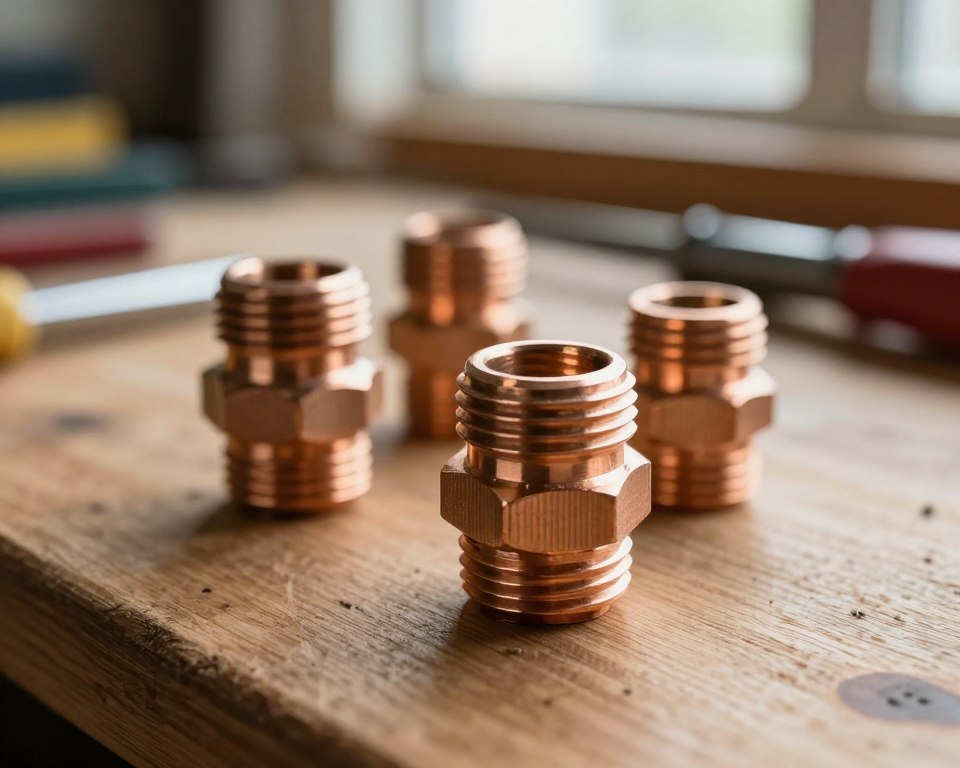
Knowing the parts and construction materials is key to choosing the correct 3/4 copper compression fitting. They create a tight seal without the need for soldering. They handle a variety of pressure and temp levels.
Breakdown Of Fitting Parts
The primary parts are the fitting body, a sleeve, and the compression nut. Tightening the nut it pushes the ring against the body. This compression seals the pipe, stopping leaks.
Premium sets often contain an seal ring made from Buna or EPDM. Certain sets also provide a spare O-ring, making maintenance easier. These extras are common in high-end fittings for liquid cooling and HVAC systems.
Fitting Materials And Coatings
Typical metals are pure copper, brass, and nickel-plated brass. Copper parts are ideal for copper pipes and reducing galvanic corrosion. Brass fittings are standard for water and AC lines.
Plated brass provides better corrosion resistance and a polished look. Custom caps can be coated or finished for looks and safety. Always check chemical safety when picking decorative finishes for systems handling glycol or other fluids.
Common Configurations And Related Keywords
Common forms are unions, couplings, tees, adapters. You’ll find them labeled as 3/4 compression unions, couplers, or tees for splitting pipes.
When choosing components, check the nut size. A 3/4 brass compression coupling is a robust choice if you want brass. Review the performance specs, such as pressure rating, temperature range, and if spares come with it.
See the table below to guide selection.
| Configuration | Metal | Usage | Details |
|---|---|---|---|
| Compression union | Copper/Brass | Connecting 2 tubes | Good for repairs and modular systems |
| 3/4″ Coupler | Brass/Plated | Joining same size pipe | Often sold with ferrules and nuts included |
| Brass Coupler | Brass | Water & HVAC | Corrosion resistant |
| Compression tee | Brass/Plated | Splitting lines | Check PSI rating |
| Straight adapter | Various | Fitting to valve | Check threads/seat |
Refer to this guide to match a nut and ring to the right fitting. Proper matching avoids drips and makes install faster. Keep spare ferrules and an O-ring ready for field repairs.
Installation Tips And Troubleshooting For 3/4″ Compression Fittings
Verify that the tubing and fitting match the connector. Confirm the pipe is the right grade (M, L, K, ACR) and is 3/4″ OD. Check for ASTM and NSF markings when applicable. Choose brass or copper fittings that match the tube metal to avoid galvanic corrosion.
Cutting and cleaning the tube are essential. Use a pipe cutter for a square cut. Deburr the inside edge and clean outer burrs for proper ring fit. Slide the compression nut and ferrule on the pipe before inserting it into the fitting.
Prepping pipes and picking fittings
Determine the fitting style for your connection. A 3/4 compression union connects ends, while a 3/4 compression coupler links straight pipes. A 3/4 fitting may include special ferrules or O-rings for particular jobs. Opt for premium parts in high-pressure systems or refrigeration work.
Install walkthrough
Screw by hand the nut until the tube bottoms out inside the fitting. Use a wrench to turn the nut as specified in instructions. Certain high-end parts have O-rings and need minimal torque; follow the manual.
If the fitting uses a ferrule, tighten until it compresses and grips the tubing. If there is an O-ring, inspect its seating before final torque and keep a spare O-ring available for repairs. For critical or buried lines, test pressure at design pressure and check for leaks.
Leak causes and solutions
Leaks often stem from a crooked cut, missing or damaged ferrules, poorly seated pipe, or incorrect nut torque. Tightening too much can crush rings and under-tightening leaves the joint loose. Replace damaged ferrules or O-rings and re-cut the tube squarely when needed.
Repeat leaks may indicate the fitting needs replacement or a permanent join like soldering or brazing is better. Stock extra 3/4 compression nuts, ferrules, and O-rings in your toolbox for fast fixes. A union or a 3/4 compression coupler can be easily changed if replacement is needed.
| Problem | Reason | Quick Fix |
|---|---|---|
| Slow drip at joint | Loose nut or bad ferrule | Hand-tighten, then wrench-turn to spec; re-seat tube and replace ferrule if needed |
| Instant leak | Damaged O-ring or ferrule, or tube not fully inserted | Disassemble, inspect O-ring and ferrule, re-cut tube square, replace parts |
| Constant leaking | Deformed ferrule from over-tightening or wrong material match | Replace fitting or solder |
| Union leak | Misalignment or improper nut torque on 3/4 compression union | Align, check nuts, tighten, test |
| Joint fails under pressure | Wrong fitting/material | Use certified coupler, test |
Purchasing Guide For 3/4 Compression Fittings At Installation Parts Supply.com
Start by checking the specs and material. Select brass, nickel-plated brass, or copper, ensuring they have clear corrosion resistance ratings. Listings should detail pressure/temp specs. It’s also important to see if it comes with rings or spares. Know the recommended tightening method, whether by hand or wrench.
Choose the fitting type based on your project’s needs. A 3/4 compression union is good for joining two pipes same diameter. For straight runs, a 3/4 compression coupler is appropriate. A 3/4 brass compression coupling is perfect for transitions or when aesthetics are a concern. Keep extra compression nuts and ferrules for fixes.
Make sure it fits 3/4″ OD tubes. Sellers should list M, L, K, ACR pipes. For HVAC or refrigeration projects, verify usage with ACR copper and the refrigerants used.
Look at the finish and precision features of the parts. High-end parts might have color or plated finishes that stop tarnish and look better. High-quality seats and machined ferrules reduce leaks and make installation easier.
Before making a purchase, inquire about availability and shipping times. Installation Parts Supply.com often has a wide range of fittings and tubes in stock. Note the shipping cutoffs if same-day processing is required.
Check the warranty and return policies. Seek good coverage and a straightforward return window, such as a 30-day policy for new items. Keep receipts and order info handy to expedite any claims for bad parts.
Use the checklist below to simplify selection:
- Material and corrosion rating
- Pressure/Temp limits
- What’s included
- Tube compatibility
- Fitting type: 3/4 compression union, 3/4 compression coupler, or 3/4 brass compression coupling
- Availability, shipping lead time, and warranty terms
Wrap Up
Opting for a quality 3/4 fitting guarantees tight seals. These are essential for residential and commercial systems. They fit common copper tube types—M, L, and K. Therefore you can pick the best part for the job, guaranteeing life under normal conditions.
To succeed, make sure you know the tubing type and size. Prep and clean the tube ends. Choose the fitting material and configuration that suits your needs. Using these tips and obeying instructions reduces leak risk and the need for rework.
For good parts, turn to Installation Parts Supply.com. They offer dependable stock, certified copper, and clear policies on warranty and returns. By checking specs, checking availability, and selecting premium 3/4 compression fittings, you get solid connections every time.
Related: Signs It Time to Replace Your 3/8 Compression Coupling